
Two PLA straw making machines may look similar, yet their screw size, cooling capacity and cutting system can lead to different production results. Before comparing prices, compare the complete line against the straw you actually need to manufacture.
This guide explains the reference specifications for SJ50 and SJ65 configurations, the difference between kg/h and pieces/min, and the checks to agree before shipment. For the equipment overview, explore our biodegradable straw making machine.
SJ50 vs SJ65 PLA straw making machine specifications
The figures below come from the reference configuration sheet. They are selection references, not verified trial results or guaranteed performance for every material and straw size. The final quotation and agreed acceptance test define the supplied equipment and its performance targets.
| Specification | SJ50 | SJ65 |
|---|---|---|
| Screw diameter | 50 mm | 65 mm |
| Screw L/D ratio | 33:1 | 33:1 |
| Screw and barrel material | 38CrMoAlA | 38CrMoAlA |
| Main motor power | 15–18.5 kW | 22–30 kW |
| Heating zones | 6 | 6–7 |
| Heating power | 12–18 kW | 24–30 kW |
| Reference extrusion output | 25–35 kg/h | 45–70 kg/h |
| Reference production speed | 400–1,000 pieces/min | 600–1,800 pieces/min |
| Listed materials | PLA and PLA+PBS blends | PLA and PLA+PBS blends |
| Controls | PLC and touchscreen | PLC and touchscreen |
The ranges represent configuration options. They do not mean that every combination of diameter, wall thickness, length and speed is achievable simultaneously. Please identify the specific resin grade and blend before equipment selection.
Which model fits your production plan?
Start with your product list and expected orders. SJ50 is the smaller of these two reference configurations, while SJ65 offers a higher listed extrusion-output range. However, screw diameter alone does not determine the best choice.
For each proposed model, ask for the expected saleable output at your required straw dimensions. Also compare the cooling system, cutting capacity, changeover procedure, utilities and floor layout. A larger extruder is useful only when the rest of the line and your production plan can support it.
If you manufacture several straw sizes, share the full range before selecting the die and downstream equipment. You can also review our straw extrusion line options to discuss the required product mix.
Need help comparing SJ50 and SJ65? Send your material, straw dimensions and target output.
Straw diameter, wall thickness and cutting options
The reference sheet lists the following product ranges and options:
| Item | Reference range or option |
|---|---|
| Straw outside diameter | 3–12 mm |
| Wall thickness | 0.10–0.35 mm |
| Cut length | 80–300 mm; customization available |
| End-cut options | 90°, 45° or 60°, subject to the selected cutter |
| Colors | Single, two or three colors |
| Stripe options | Straight or spiral stripes, with the appropriate configuration |
| Auxiliary extruder | Optional 25 mm unit |
Confirm your required dimensions and cut-end appearance with a drawing or sample. Color and stripe options require the corresponding auxiliary extrusion and tooling configuration; they should be listed explicitly in the quotation.
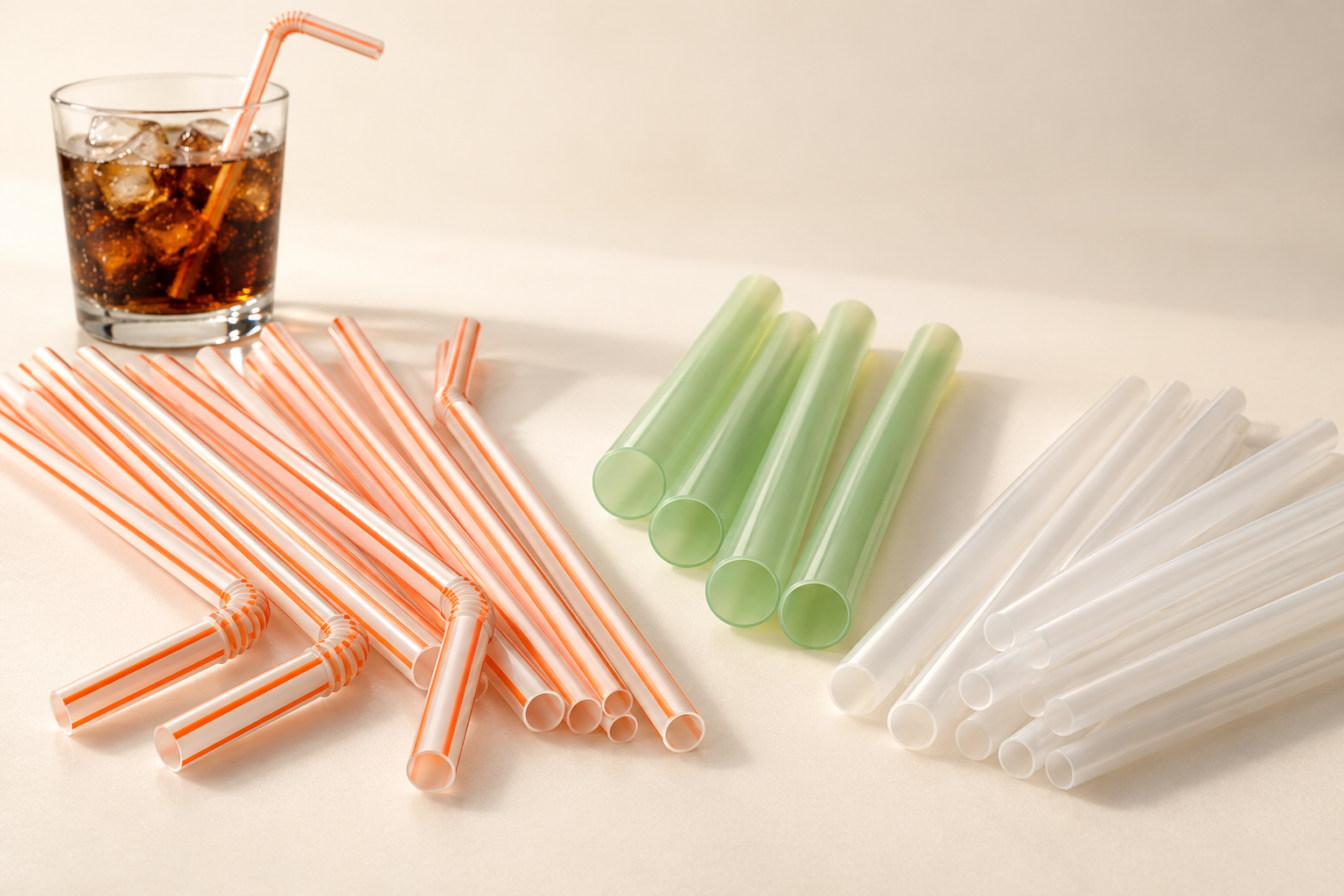
Illustrative straw styles. Final material, dimensions and finish are confirmed through the agreed specification and samples.
How to compare kg/h with pieces per minute
Extrusion output in kg/h measures material throughput. Pieces per minute measures the number of cut straws. They describe different parts of production and should not be treated as interchangeable capacity claims.
For a known straw weight, a theoretical conversion is:
Pieces/min = output in kg/h × 1,000 ÷ straw weight in grams ÷ 60.
For example, 30 kg/h and an assumed weight of 0.5 g per straw give a theoretical 1,000 pieces/min. This is a calculation example, not a machine test result. Actual saleable output also depends on cutting capacity, process stability, startup losses and rejected pieces.
When comparing quotations, request output at the same resin grade, diameter, wall thickness and cut length. Ask suppliers to state whether the figure refers to gross extrusion, cut pieces or accepted finished straws.
Cooling, haul-off and cutting: check the complete line
The reference cooling configuration includes a 304 stainless steel tank with a listed length of 4.5–6 m. The sheet also lists adjustable vacuum of −0.04 to −0.08 MPa. These are equipment references, not universal operating settings for all PLA grades.
Agree the cooling arrangement with the selected material and straw geometry. Water conditions, line speed and downstream adjustment must be considered together. A quoted extruder capacity is not enough to establish the finished-product capacity of the complete line.
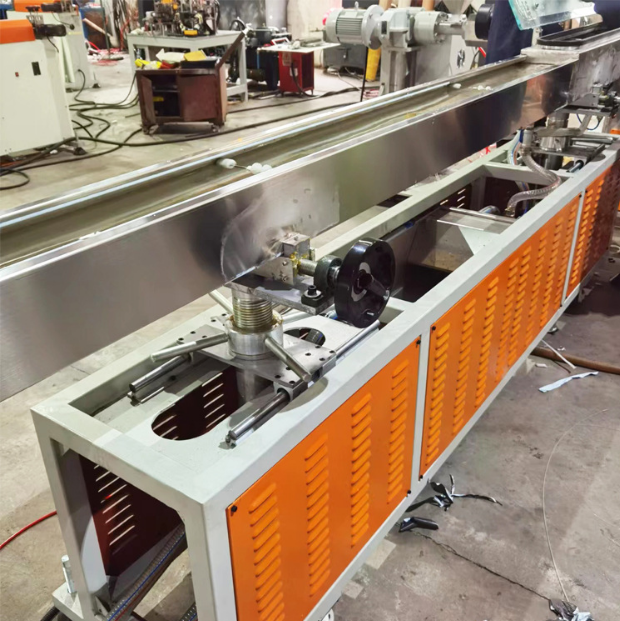
Cooling equipment illustration from our equipment image collection. The final tank and accessories follow the agreed configuration.
Check how the haul-off and cutter are coordinated. During a trial, inspect cut length, end quality and dimensional consistency at the agreed operating speed. Specify the measurement method and acceptance tolerance before the test.
Power, layout and auxiliary equipment
The reference sheet lists three-phase 380 V / 50 Hz power. Your destination voltage, frequency and electrical requirements must be confirmed before production. Do not assume that a reference electrical configuration matches your site.
Main motor power and heating power are installed ratings, not a measured energy-consumption figure. A useful running-cost comparison requires measured consumption under agreed production conditions, including the auxiliary equipment in the test scope.
Request an itemized quotation covering the extruder, die, cooling system, haul-off, cutter and controls. Confirm separately whether material drying, loading, cooling-water equipment, auxiliary extruders and collection or packing equipment are included. Drying and processing settings should follow the selected resin supplier’s guidance and the agreed trial procedure.
Pre-shipment testing and acceptance checklist
Agree the following before the line is tested:
- Material: exact resin grade, blend and preparation method.
- Product: diameter, wall thickness, length, color and cut-end specification.
- Performance: target accepted output, test duration and permitted reject level.
- Measurements: sampling frequency, instruments and agreed tolerances.
- Equipment: supplied units, tooling, accessories and electrical configuration.
- Evidence: operating video, sample measurements and trial records.
- Delivery: packing list, manuals, drawings and startup arrangements.
PLEXTRUD arranges pre-shipment commissioning. Samples can be sent, or video acceptance can be arranged, according to the agreed project scope. A useful test shows the specified product running steadily and provides measurable results.
Send your drawing or sample details to discuss a suitable configuration and acceptance plan.
Installation, training and warranty
Overseas on-site installation, commissioning and operator training can be arranged for complete-line projects. Confirm the service scope, schedule and travel arrangements in the quotation.
The equipment warranty is one year from the date the customer receives the equipment. Screws, barrels, motors and frequency inverters with material or manufacturing defects qualify for free replacement under the warranty terms. Normal wear, consumables and damage caused by improper operation are excluded.
Unless otherwise agreed, the customer bears international shipping costs. Returning old parts requires prior confirmation. Long-term spare parts supply and technical consultation remain available after the warranty period.
Complete lines receive the agreed warranty and service support. Individually purchased components do not include on-site service. Separate die orders require drawings and clear specifications before acceptance. Learn more about PLEXTRUD.
Frequently asked questions
Is SJ65 always better than SJ50?
No. SJ65 has a higher reference output range, but selection should follow your product dimensions, material, expected orders and complete-line requirements. Compare agreed output for the same product before deciding.
Are the listed production speeds guaranteed?
No. The listed ranges are references from the configuration sheet. Actual performance must be confirmed for the selected material, product dimensions and line configuration through an agreed trial.
Can the machine process PLA+PBS?
PLA+PBS blends are listed in the reference sheet. Compatibility and processing conditions need confirmation for the specific grade and formulation. Provide the material data sheet before equipment selection.
Can one line make different straw sizes?
A configured line can cover an agreed range. Required tooling changes depend on the dimensional span and die design. Share both current and future sizes so the quotation identifies the necessary dies and internal parts.
Does buying a PLA straw machine certify the finished straws?
No. The equipment purchase does not itself establish food-contact compliance or compostability certification for the finished product. Define the documentation and testing needed for your material and intended market separately. For EU examples, see our guide to biodegradable straw materials and market requirements.
Request a PLA straw making machine quotation
To receive a relevant proposal, send your resin grade, straw outside diameter, wall thickness, cut length and target output. Include your preferred colors or stripes, cut-end style, destination country, site power supply and available layout.
PLEXTRUD can configure the line around these requirements and agree the trial, delivery and after-sales scope before the order.
 English
 Español de México
 Português do Brasil
 Tiếng Việt
Join the Conversation
Have questions about this topic, or want to share your experience with extrusion lines? We read every comment and reply personally -- your insight helps the whole community.
Your thoughts matter -- share what's on your mind and help others in the industry.